Like Us

Thursday, May 29, 2014


SAHASRADHARA - One Thousand Streams
Noutonki Kolkata is organizing Sahasradhara Natya Utsav, a festival celebrating the spirit of traditional indigenous performances of Bengal. The festival will start its journey from this year with the theme of Radha-Krishna. Besides the performances, Noutonki Kolkata is also organizing interactive sessions in collaboration with “Project Pala Gaan”, Jadavpur University. This part of the event will comprise of firstly, discussions by eminent theatre personalities, scholars, students and theatre-workers; and secondly, interaction and workshop with the traditional performers.
Out of the hundreds of traditional genres, this year we are honored to present Chor-Chunni from Jalpaiguri, Pala-bandi Jhumur commonly known as Nachni from Purulia and Leela-Kirtan from Kolkata.
Please come, and let's make it a festival.
Sahasradharay

Wednesday, December 25, 2013

Durgeshnandini
A Noutonki Kolkata presentation based on Bankim Chandra Chattopadhyay. 

Script & Direction: Abhishek Basu 
Music: Prakriti Dutta 
Choreography: Mahua Mukherjee
Set & Logo: Hiran Mitra
Light: Bablu Sarkar
Costume: Udayshankar Ray
Artwork: Kawshik Aki
Players: Apurba Kumar Saha, Dipak Kumar Sarkar, Gopa Sur, Joy Dutta, Goutam Das, Korak Samanta, Gulshanara, Soumen Haldar, Ratna Chakraborty, Sumana Bhattacharya, Sandip Ghosh, Priyanka Bhattacharya, Pushpam Chattopadhyay


Sunday, September 1, 2013

দুর্গেশনন্দিনী - টুকরোটাকরা (২)


    "নিশীথকালে জগৎসিহ শৈলেশ্বরের মন্দির হইতে যাত্রা করিলেনআপাতত: তাঁহার অনুগমনে অথবা মন্দিরাধিষ্ঠাত্রী মনোমোহিনীর সংবাদ কথনে পাঠক মহাশয়দিগের কৌতূহল নিবারণ করিতে পারিলাম নাজগৎসিংহ রাজপুত, কি প্রয়োজনে বঙ্গদেশে আসিয়াছিলেন, কেনই বা প্রান্তরমধ্যে একাকী গমন করিতেছিলেন, তৎপরিচয় উপলক্ষে এই সময়ে বঙ্গদেশ সম্বন্ধীয় রাজকীয় ঘটনা কতক কতক সংক্ষেপে বিবৃত করিতে হইল অতএব এই পরিচ্ছেদ ইতিবৃত্তসম্পর্কীয়পাঠকবর্গ একান্ত অধীর হইলে ইহা ত্যাগ করিতে পারেন, কিন্তু গ্রন্থকারের পরামর্শ এই যে, অধৈর্য ভাল নহে।"

দুর্গেশনন্দিনী, 'তৃতীয় পরিচ্ছেদ : মোগল পাঠান'


Sunday, August 18, 2013

DURGESHNANDINI

দুর্গেশনন্দিনী ও কিছু প্রাপ্তি
'দুর্গেশনন্দিনী' ফিরে দেখা বললে অনেকে অনেক রকম করে খুঁজে নেবেন। 'নৌটঙ্কি কলকাতা'-র সদস্য হিসেবে আমাদের ফিরে দেখাটাও আবার আমাদের নিজেদের মতো করেই। কিন্তু ব্যক্তিগতভাবে বিচ্ছিন্ন নয়। একদম সংক্ষেপে, ইতিহাসে হাঁটতে হাঁটতে উনিশ শতকীয় সমাজ-চেতনার স্বাদগ্রহণ। সঙ্গে পালক হিসেবে যুক্ত হয়েছে, বিদেশি প্রসেনিয়াম থিয়েটাররূপের বাড়বাড়ন্তের সময়ে বাংলার আদিনাট্যরূপগুলোর সঙ্গে নিজেদের জানা-না জানা ঝালিয়ে নেওয়া। সব মিলিয়ে দুর্গেশনন্দিনী নিয়ে আমাদের প্রতিদিনের মহলা, মহলায় উঠে আসা প্রতিবাদ, সেই সমাজটাকে খানিক খানিক বোঝার প্রচেষ্টা, প্রসেনিয়ামের ভিতর বাংলার কথা কওয়া নাট্যরূপ তুলে ধরার প্রস্তুতি মোটামুটি ভালই এগোচ্ছিল। সেই যাত্রাপথে একটা বুকমার্ক হিসেবে আমাদের ১১ আগস্টের ওয়র্কশপ। আমাদের পরিচালক অভিষেকদার আশ্বাসমতে, আমরা দুর্গেশনন্দিনীর যাত্রাপথে অনেক কিছুই হঠাৎ পড়ে পাব। প্রথম পাওয়া শুরু হল গৌড়ীয় নৃত্যের কৃতী মানুষ অধ্যাপিকা মহুয়া মুখোপাধ্যায়ের কাছে সারাদিনের কর্মশালা। গৌড়ীয় নৃত্যের কর্মশালা হলেও, আমাদের আদুরে-অনভ্যস্ত শরীরে সেদিনটা একটু ভেঙেচুরে ঝালিয়ে নেওয়ারই ছিল।
নাটকের কাজে আবার নাচের ওর্য়কশপ? এই বিতর্কের অবসান মহুয়াদি নিজেই করেছেন। ৬৪ কলার প্রত্যেকটি একে অপরের সঙ্গে যুক্ত। তাই একের সঙ্গে অন্যের যোগ কিভাবে, কিরূপে তা জানলাম মহুয়াদির কাছে। পাশাপাশি অন্য রকম ফর্মে দুর্গেশনন্দিনীকে কীভাবে উপস্থাপনা করা যায়, সে নিয়ে এতদিন অভিষেকদা যা বলত, তার একটা ছবিও বোধহয় আমরা দেখতে পেলাম। বাংলার কলা, ভাস্কর্য, প্রাচীন কথায় লেপ্টে থাকা নাচের অনুষঙ্গ তাই নাটকের মতো জনযাপনের ফর্মে আসতে তো বাধ্য। প্রথম দিনের কর্মশালায় আমাদের বিস্ময়াবিষ্কারই ছিল প্রাপ্তি। দুর্গেশনন্দিনী এমন কত প্রাপ্তির ঝুলি নিয়ে সান্টাক্লজের মতো অপেক্ষা করছে কে জানে!

Saturday, July 20, 2013

দুর্গেশনন্দিনী - টুকরোটাকরা (১)

বাবা আশুতোষ চক্রবর্তী রেলে কাজ করতেন বলে, পড়াশোনার জন্য কাকা প্রসাদ চক্রবর্তীর কাছে থাকতেন, তুলসী চক্রবর্তী। প্রসাদবাবু, ষ্টার থিযেটারে হারমোনিয়াম আর তবলা বাজাতেন। সেই সূত্র ধরেই অভিনয় জগতে প্রবেশ। তৎকালীন ষ্টার থিযেটারের মালিক ছিলেন- অপরেশ চন্দ্র মুখোপাধ্যায়। মাত্র ১৭ বছর বয়সেই চোখে পড়ে যান অপরেশবাবুর। সালটা ছিল – ১৯১৬। এই অপরেশবাবুই তালিম দেন তুলসী চক্রবর্তীকে। টপ্পা গান, পাখোয়াজ বাজানো সব শিখেছিলেন। ১৯২০ তে প্রথম ষ্টেজে অভিনয় করেন। নাটকের নাম ছিল:- দুর্গেশনন্দিনী।


তথ্যসূত্রঃ রামকৃষ্ণ ভট্টাচার্য্য

Wednesday, June 26, 2013

Telling the Tale


When someone talks about 'Deyal', I find myself in a little spot. What to say? Designing or directing a production is not unusual; I can see from the revered 'outside'. But around ‘Deyal’, there is no 'outside' to it, as I am the only actor on stage. Your appreciations and criticisms are humbling, to say the least. And more than that, indicative of the immense expectations that I should strive to fulfill – as an actor, a performer. I can only say, thank you, please bear with me, be there, with us.
An Other thing about 'Deyal', the mode of storytelling, which perhaps captured your imagination, is driving us crazy. So much that it won’t leave us even if it is not a solo performance. It is maddening, really. One might say, after all these years; why are we taking back the theatrical, the performative, to the tyrannical domain of the descriptive, narrative. Or, else, why should we be apologetic? As someone said, my consciousness is not illuminated with ultimate radiances. Perhaps, only in a roundabout way, I came to feel (not ‘know’) the fathomless; there is no honest ‘outside’ to it!

Saturday, June 22, 2013

দুর্গেশনন্দিনীঃ বঙ্কিমচন্দ্র চট্টোপাধ্যায়ের ১৭৫


নৌটঙ্কি কলকাতার পরবর্তী প্রযোজনা বঙ্কিমচন্দ্র চট্টোপাধ্যায়ের আখ্যান অবলম্বনে দুর্গেশনন্দিনী । কাজ চলছে। আগামী ২৮ জুন, শুক্রবার, বঙ্কিমচন্দ্র চট্টোপাধ্যায়ের ১৭৫ তম জন্মদিন। আমাদের মহলায় সেদিন দুর্গেশনন্দিনী-এর প্রস্তুতিপর্বের কর্মশালা, আলোচনা আর একটি-দুটি দৃশ্যের খসড়া অভিনয় হবে। নিতান্ত কেজো একটি জন্মদিন পালন!


Saturday, June 15, 2013

Deyal- audience diary 3

নিজেকে খুঁজে পাই
আমি এর আগে 'দেয়াল'-এর কথা শুনিনি। বন্ধুর আমন্ত্রণে শিশির মঞ্চে বেশ কৌতূহল বশেই গিয়েছিলাম 'দেয়াল' নাটকটি দেখতে। নাটকের নিয়মিত দর্শক নই ফলে একক অভিনয়, নির্দেশনা, সব মিলিয়ে অন্য রকম কৌতূহল ছিল। হল থেকে বেরিয়ে আসার সময় মনে হচ্ছিল এক রকম আলিঙ্গনে আমায় আবিষ্ট করে রেখেছেন অভিনেতা-নির্দেশক অভিষেক বসু। সমকালীন চিন্তা-চেতনার মানুষ হিসেবে নিজের চারপাশের নানা দেয়ালে আটকে থাকা মন যেন একাত্ম হয়ে মিশে যায় বশীর আর নারায়ণীর মধ্যেকার শয়তানরূপী দেওয়া। নিয়ত যে দেওয়াল ভেঙে উল্লাসে মেতে উঠতে চাই, সে দেওয়াল বোধহয় কোনওদিন ভাঙা যায় না! আর সেই বিশ্বাস এক  অবিস্মরনীয় অভিনয়ে মনে গেথে দেন অভিষেকবাবু। বাহ্যিক জগত থেকে উপড়ে তুলে এনে অভিনেতা বলেন দেখো আমার চমৎকারিত্ব। আমি মন্ত্রমুগ্ধের মতো দেখি। নিজেকে অপরাধী মনে হয়, কেন এই অভিজ্ঞতায় নিজেকে এর আগে সামিল করিনি। নৌটংকি কলকাতার কাছে অনুরোধ, এই রকম আরও কিছু উপহার দিয়ে মুগ্ধ করুন আমাদের।

                                                                                                                                                                              সপ্তর্ষি ব্যানার্জি

Sunday, June 2, 2013


Deyal - Audience Diary 2 

Watched DEYAL by Noutonki Kolkata. Did it ring a bell? Will it help us break free and breakthrough the walls of our morbidity? Noutonki Kolkata's attempt to trace back to the roots of theatre which was devoid of glamour and technical magnanimity, was incredible. Its endeavour to revive and resuscitate Bengals’ traditional theatre form from its near-extinct state is a relief.
 
                                                        - উদয় শংকর রায় 

Reading the novel was an experience in itself. A very heart touching narrative “Mathilukal”, originally in Malayalam by Vaikom M. Basheer was translated to Bengali by Manabendra Bandopadhyay as “Deyal”. The stage adaptation of DEYAL, the visual manifestation was spectacular.
Noutonki Kolkata presented the great literary work for the first time in Bangla theatre as a monologue. And what a staging it was – a jaw-dropping experience. It was an exceptionally delicate and sensitive portrayal of a prisoner – of political rationale and love. It depicts how the same prison of dislike, dejection transforms into the most coveted space for him. It was enormously poignant to watch how a man looking forward to his freedom, even contemplating a getaway from the prison, all of a sudden was jolted by the news of his release. This separation perhaps was the justification of Deyal. It reflects how all our desires and longings are often hammered against an indiscernible wall of reality.

Abhishek Basu once again proved his mettle both as a director and actor by carrying off the characters – Basheer, Narayani, Jailor on his solo shoulders with great poise and élan. He rendered an extremely smooth and spontaneous performance devoid of any extravagance. His sensibilities and responsibilities both as a director and actor reached colossal heights with the extremely sensitive portrayal of Narayani in particular. Portrayal of women characters by male actors have been quite an age old practice. But the question always remained how well was it ever justified. Is it enough to feel like a woman and portray her character or the mannerisms of a woman are important too? If so then how well was it accomplished? Or it takes a little more than just feeling like a woman – being a woman? The question remains even after “Deyal” is staged.
The stage presentation was equally enhanced by minimalistic yet extremely effective set design planned by Abhishek Basu, a dominant light arrangement by Babloo Sarkar and a simplistic yet convincing costume by Uday Sankar Ray. The music composition by Abhishek Basu was beautifully arranged and thought-of. However it was heart wrenching to see the performance falling short of reaching the pinnacle of excellence because of an ill-coordinated and out-of pitch rendition of the song that could have been the turning point of the entire play. Improvisation is not a child's play. The proverb " PRACTICE MAKES A MAN" still holds good even to dare to think of improvising on stage. As a team work Noutonki Kolkata has excelled itself once more with Deyal.

Thursday, May 30, 2013

RIP Rituparno Ghosh


Ik palak jhalak da mela he
kujh kar le eho wela he
-- Baba Bulleh Shah

(Time is short, one flutter of eye/ do something this is the time)
 

Monday, May 27, 2013

Deyal (wall). audience diary...

দেয়াল দেখার পর

একটা মঞ্চ, মাটি থেকে আকাশ পর্যন্ত। একটা বাক্স, স্বচ্ছ অদৃশ্য দেয়ালের। অথবা, একটা বল। চলমান। ভিতরে আমি, নামতে থাকি আমার মধ্যে। চারপাশের প্রাচীর ক্রমশ সঙ্কুচিত হয়। আমাকে চুপসে দিতে চায়। আমি জাগি। একটা বিস্ফোরণ। চারপাশে ছড়িয়ে পড়ে অসংখ্য আমার টুকরো। বুকে জড়িয়ে আদর করি। চুমু খাই। আমার ভিতর থেকে ধমকে ওঠে আমার ওয়ার্ডার। ছুটে পালাতে থাকে আমার আত্মজেরা। আমিও ছুটতে থাকি পিছু পিছু। পায়ের গতিতে শূন্যে ঘুরতে থাকে গোলক। ক্লান্তিতে জিরোতে থাকি। মার্ক্স, মোহনদাস আমার কানে কানে বলে যান মুক্তির মন্ত্র। দূরে ঈশ্বরের ছায়া পড়ে। সব ব্যর্থ ফিরে যায় মহাশূন্যে। স্থির বসে দেখি সুপারের পায়চারি। আমার বন্দিত্বের যন্ত্রণা ঘষটাতে থাকি জেলের গরাদে। অসহ্য কাতরানিতে মসৃণ হয় পাটাতন। তীব্র গোঙানিতে ফাটল ধরে দেয়ালে। চোরাপথে ভেসে আসে বকুল-গন্ধ। আর্দ্র হাওয়ায় চাষ করি টকটকে লাল গোলাপ। নেমে আসে প্রেয়সীর নরম আঙুল। বিপরীত দিকে খুলে যায় জেলের গেট। আমার জেলর ঘোষণা করে আমার মুক্তির খবর। আমার মাথার পিছনে ফুটে ওঠে দুটো চোখ। নরম ইশারায় তাকিয়ে থাকে মায়াময়। পিঠের দিকে একটা হাত বের হয়। ক্রমশ বড় হয়ে ছুঁয়ে নিতে চায় আমন্ত্রণ। কিন্তু, আমার পা ছুটতে থাকে খোলা মাঠে। ছুটতেই থাকে। আমাকে ঘিরে ছুটতে থাকে আমার দিকচক্রবাল। পরিধি বাড়ে, কমে। কিন্তু, কিছুতেই পেরনো যায় না। পুড়িয়ে অতীতে পাঠাই আমার রোজনামচা। আসলে, আকাশে উড়িয়ে দিই, আগামীতে।
               
                              সুপ্রকাশ প্রামাণিক
              ২৬। ০৩। ২০১৩  

Friday, May 24, 2013

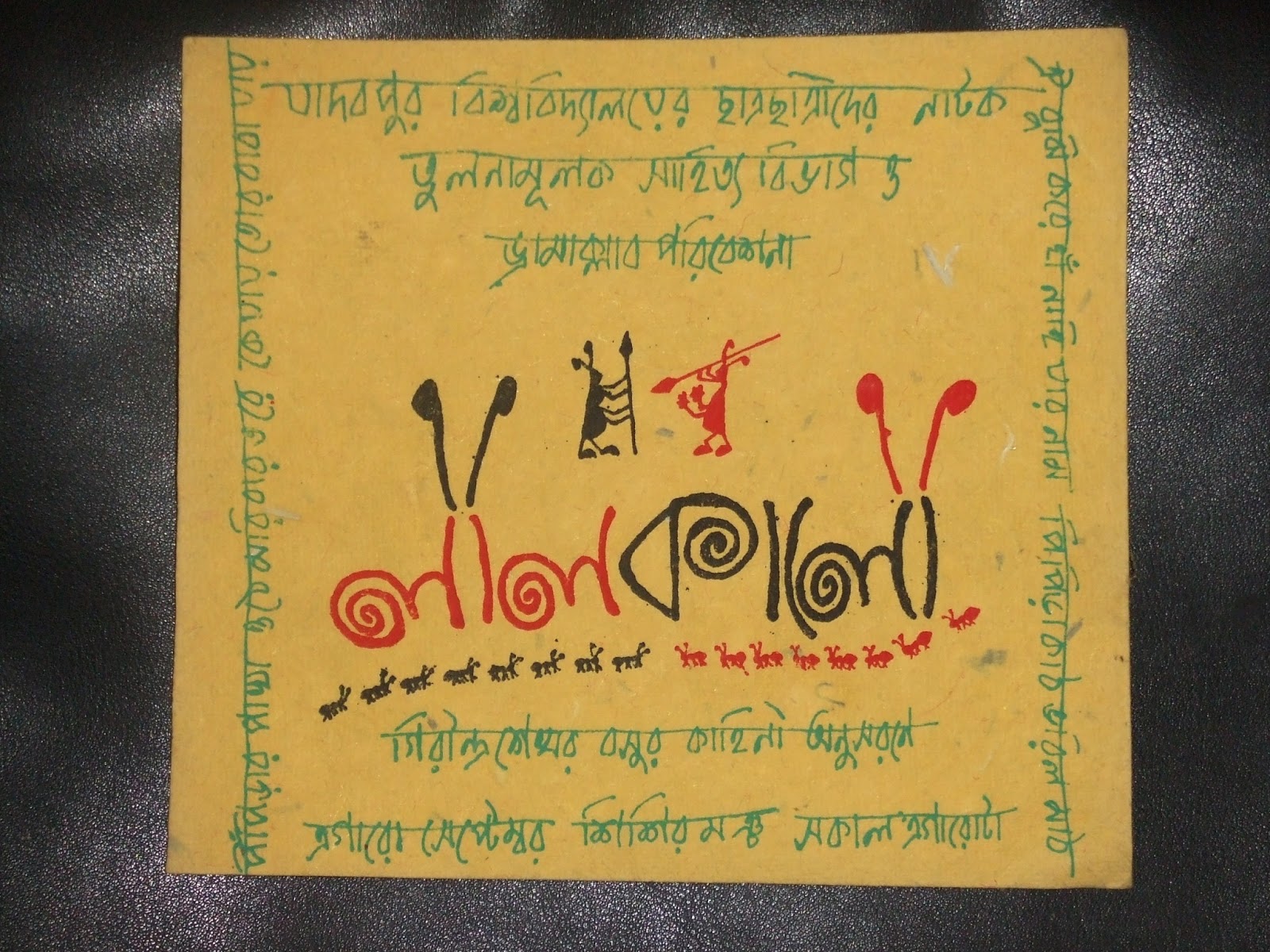
Lal Kalo


The Lal Kalo invitation card and a snap from the rehearsals. Someone demanded that these be published. With love.

Thursday, May 23, 2013

Hi everyone.
Seems a long time.
Finally, we are back. With a few enthusiasts.
Hope to be there, with your support.
Happy reading!

Deyal - The Wall


Walls protect us, from insecurities of reality or virtuality. Do they? Or we simply create them to alienate ourselves? Whatever, we still live within walls, whether tangible or not. This wall has been the subject of Mathilukal (meaning Walls) - a Malayalam novel written by Vaikom Muhammad Basheer in 1965. It is one of the most cherished and well-known love stories in Malayalam. It is no exception to his disguised simplicity and remarkable story-telling. Basheer weaves a web of drama that takes place not just within the four walls of a prison cell, but one that happens on both sides of a wall. The wall that separates two cells, two convicts, two souls, two entities, yet that unites them by love and longing. The theme of the novel, focuses on the love between Basheer, the protagonist - a political prisoner, and Narayani, a female inmate, who remains unseen throughout. The author's story telling is subtle yet intimate. He moves from one emotion to another with élan and poise and often sights experiences of his own life. Hence, though the broad frame is autobiographical and the narration is first person, the details seem to be full of fantasy, yet it is not an autobiography. Basheer, who is jailed for writing against the then British rule, befriends his fellow-inmates and a considerate young jailor. His loneliness becomes manifold once his prison mates are released one by one. His world revolves around his garden and a trance inflicted upon him by a fragrance - one of a woman. One day, Basheer hears a woman's voice from the other side of the wall – the women's prison. This voice mesmerizes him and eventually the two jailbirds become lovebirds. They exchange gifts, and their hearts, without meeting each other. Narayani then comes up with a plan for a meeting a few days later. But before that could materialize, Basheer is released, unexpectedly. For once, he does not want the freedom he had craved for.
  Just as the wall of the cell separates the lovers, Basheer uses the wall as a metaphor for every wall/obstruction that surrounds us. This creation of Basheer was translated into Deyal by Manabendra Bandopadhyay. It is not just any translation, but an effort to bring the best of Indian regional literature to a wider literary mass. 
 Noutonki Kolkata in its endeavour to break through the walls of rigidity in theatrical productions attempted a stage adaptation of Deyal as a tool to express theatrics in a form free from the walls of "Dos" and "Don'ts".  The presentation was an effort to establish a new form of expression via theatre where for the first time it ransacked the norms of the traditional form and gave way to a whole new dimension to theatre. One can see all the faces of Deyal coming alive through a solo actor. This was painstakingly achieved by balanced yet minimalistic usage of props, which defined each character very clearly. The portrayal of Basheer and Narayani at the same time was a critical edge, yet attempted through subtle variations of mannerism nuances.

Photography courtesy @ Kawshik Aki

Friday, May 8, 2009

Hamlet, The Clown Prince: Criticising Oneself, Celebrating the Insignificant,

My views on Hamlet, The Clown Prince [Dir: Rajat Kapoor] in response to Soma Basu's Post:


Your take on Hamlet, The Clown Prince arouses the desire to write something, perhaps (as) gibberish. Actually, as someone related hopelessly to the theatre practices of Kolkata, Rajat Kapoor’s play, after a v-e-r-y long time, offered me some hope to sit through the whole of it. It entertained my senses; but this enjoyment was disturbing, once I came out of the auditorium, or, the temple. Because I couldn’t explain, even to myself, what was in it that overwhelmed me. Was it the intelligent distortion of the story? Playing around with the well-known (at least, to the intended audience) text? Use of language, gibberish and gibber-English that made the audience pay more attention to the language of theatre? And, as a consequence of which, the audience grabbed the few opportunities to understand verbal language? Maybe all these; but there was something more to it. Perhaps it was not there, it was inside us, who formed the audience. I am not talking about the ‘interactive’ part; it was obviously superficial; it could not compel many of us to interact. Then what was it?
I agree with your interpretation of the performance as a series of misinterpretations of the original. But I won’t like to look at ‘the original play only to discover the plat [plot? Play?] in its modern context’. It is not contemporaneous to me, at least not spatially. Kapoor and his clowns harp on the mere existence of the original only as a pre-text to the performance. And does it really ‘see-saw between the reality and illusion’? Here comes the much-misunderstood notion of the absurd.
Absurd is not about illusion and unreal; it explores our realities for meanings through their incongruities. In that sense, this Hamlet may be called absurd. But not for the use of gibberish; spoken language can hamper the theatrical at times, and this play is simply trying to overcome that through this ‘stylization’. I am more for the insignificant, and the everyday in it. If chapliensque is what Kapoor is after, then it seems more appropriate. The tired comedians are trying to enact the tragic, and this attempt itself, being opaque, in a reversal, turns their enactment into a meta-comedy. I believe ‘nobody’ in the audience is identifying with anyone on the stage representing ‘everybody’. On the contrary, everybody shrinks away, looking at their aberrations, excesses. The performance being untranslatable, literally, in a verbal language, seeks mandatory seeing, not looking, at the stage. There being no coherent story, on top of it, makes it impossible for the audience to understand and reduce the performance to a climaxing plot; negates most of our attempts to discern meanings in languages we are accustomed to. Like an Old Comedy, it celebrates, and simultaneously incites a complete critique in us. About the play, and through it, about ourselves. I feel that is one of the reasons why I enjoyed it all, and got disturbed. And thanks to your post, tried to translate these elusive glimpses into a more non-theatrical tongue.

Thursday, April 2, 2009

Bhut Puran - The Ghost Testament


The maiden production of Noutonki after it was registered as a group, performed in an arena, it connects at least three classic texts: Girish Ghosh’s translation of Macbeth and two short comic plays by Kamal Kumar Majumdar, Sultana Rizia and Bhut Puran, in an episodic manner. Bhut can mean both past and ghost in Bangla. Our performance tried to find out the links between the two through whatever came in handy. We were trying to introspect the internalization of the structures of fear surrounding us.

The play is all about power, the pervasiveness and omnipresence of it. The performance text comments on the politics of corruption and greed, of identity and community, which pervade our daily lives. Macbeth in a nineteenth century translation acts as a prism through which the intimate audience and the players themselves look at things and explores fantastic situations like the interactions between a Hindu Brahmin and the ghost of the person for whom he has just performed the last rites, and Sultna Rizia’s throne which is possessed. The three witches of Macbeth act as the sutradhar, connecting the episodes and commenting on their inner significance. However, the mode is comic, Noutonki believes in comedy, and the witty dialogues of the original texts were retained, which themselves are replete with inter-textual references to cultural habits, history and politics. The performance begins with two songs sung by the cast as a prelude to what is to follow. The theme song, which we still sing in our daily workshops, comments on the helplessness of the performer stuck in the labyrinth of power. Yet, s/he has to continue playing the role s/he has chosen.

Rizia Sultana begins with the throne shaking as if it is haunted, and indeed, it is; it’s the ghost of public opinion which is against Rizia being the queen, as a woman. To ensure her sovereignty, Rizia sends out a spy to kill her stepmother and her son who are plotting against her, only to learn that the spy has spotted her somewhere else; therefore, she is either an imposter or a ghost. There is another very humorous episode when a nachnewali (dancer) comes to tell her that she has been killed. Just then, her stepmother appears and demands the throne; but Rizia, pretending to be a ghost, advances to kill her.

Bhut Puran focuses on the hierarchy in the domain of the ghosts. The Brahmin meets the old ghost on his way home, who wants to possess him so that he can taste all the delicious food cooked for his shraddha, which the Brahmin is carrying back, as is custom. His greed is compounded by the fact that he died of high blood pressure and had been prevented by his doctor to eat anything ‘rich’ (tasty) before he died. Just as he is about to possess the Brahmin, the young ghost enters; though he is young, he has been a ghost for a long time, and therefore he demands that he has a greater right to possess the Brahmin. Amid the crescendo of negotiation and insults, the old ghost realizes that he is being thoroughly insulted, and faints, thus closing the play.

Episodes from Sultana Rizia and Bhut Puran were interspersed with the three witches from Girish Ghosh’s translation of Macbeth, whose vigorous movements and songs greatly entertained the audience. With rigorous physical acting and no props, the performance was visually interesting as every actor became a human prop (trees, thrones, walls) blending it with their speaking parts. The live music, both instrumental and vocal, also played a critical part in moving the play towards its open-ended culmination.

Kata bhay ase jaygo
bhangane sashane bhay
seh bhaye dukhuram ghumay
bhay lal-o
bhay re kalo
nritya kare natabor
range range pala gay
se na jane bhayer bhasan

How many fears come and pass –
Fear of turmoil – revolt, fear of power;
Dukhuram the perennial loser slumbers in that fear.
Red fears,
Dark fears,
Natabar the actor dances,
Recites plays in colour –
Not knowing how to wash it away.